

More than looks can be enhanced by a straight grin. It can facilitate brushing, improve dental health, lessen uneven tooth wear, and make patients feel more at ease in social and conversational settings. Nowadays, a lot of adults and teens are considering orthodontic treatment since contemporary dentistry alternatives are less obvious and more pleasant than earlier techniques.
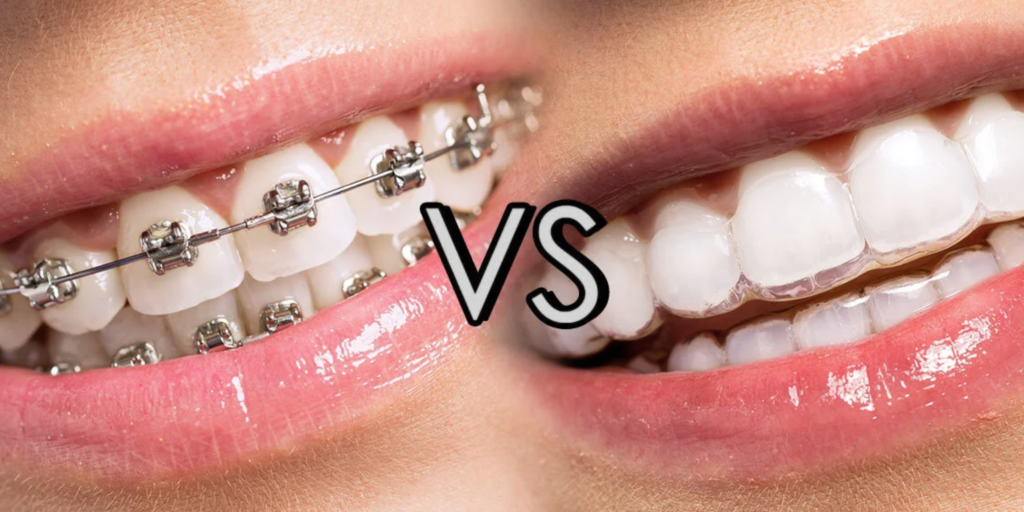
Hereon, most people confuse in invisalign vs braces, which one is best for them.
Both procedures can address alignment abnormalities, overgrown teeth, proper spacing issues, and bite problems. They do, however, function differently and accommodate various dental problems and lifestyles. Some patients desire a therapy that is almost undetectable while they are at work or school. For difficult orthodontic issues, others require further tooth mobility.
Quick Comparison: Invisalign vs Braces
Understanding the difference between the two treatments becomes easier through a direct comparison.
| Feature | Invisalign | Traditional Braces |
| Appearnace | Clear removable aligners | Metal or ceramic brackets |
| Confort | Smooth plastic trays | Brackets may irritate cheeks |
| Cleaning | Removed during brushing | Requires careful cleaning |
| Food Restrictions | Very limited restriction | Avoid sticky and hard foods |
| Treatment Complexity | Mild to moderate issues | Mild to severe issues |
| Office visit | Usually fewer appointments | Regular tightening visit |
| Discipline Needed | Must wear for 20 to 22 hours daily | Fixed to the teeth permanently |
| Visibility | Nearly invisible | More noticeable |
When it is applied appropriately, both processes may deliver valuable results. The person’s age, lifestyle, oral health status, and surgical objectives all influence the best option.
Knowing How Braces Function
Brackets and wires are fastened directly to the teeth in traditional braces. These elements progressively move teeth into better alignment by applying constant pressure.
One of the best orthodontic methods for intricate tooth adjustments is still braces. Braces are frequently more effective than clear aligners for severe crowding, rotated teeth, jaw alignment issues, and serious bite abnormalities.
Over time, modern braces have also grown significantly. Compared to older models, modern designs are more compact, comfortable, and effective. Because ceramic braces more closely match the color of teeth, some patients even decide to wear them.
Braces remain in place during therapy, in contrast to detachable aligners. This removes the worry that you won’t remember to wear them often.
When to Select Braces
For patients requiring stronger tooth mobility and more complex orthodontic treatments, braces are still quite effective.
Braces may be more beneficial for patients when they:
- Desire a long-term treatment solution.
- Have serious issues with space or crowding
- Have trouble maintaining a consistent course of treatment
- Long-term shifting of teeth must be predictable
- Significant bite repair is required
- have teeth that are impacted or rotated
Because they are unable to take off their braces, children and younger teens may have greater compliance. Delays brought on by irregular aligner usage can be avoided with fixed treatment.
Additionally, braces provide Orthodontists greater direct control over intricate tooth motions. Braces may provide quicker and more precise treatment for patients with significant bite alignment issues.
Learning about Invisalign’s Operation
With Invisalign, teeth are progressively moved into the correct locations using transparent, custom-made aligners. Because teeth shift gradually over time, each aligner tray is made especially for the patient and is changed every one to two weeks.
Patients may eat, brush, and floss normally because the aligners are removable. Because the trays are hard to see during everyday interactions, Invisalign is preferred by many teens and working professionals.
Additionally, digital scanning technology enhances treatment planning. In order to produce aligners that are more accurate and pleasant, many clinics now use precise digital models in place of conventional impressions.
Accessibility is one significant benefit. When compared to conventional braces, patients often spend less time in adjustment sessions. However, consistency is crucial to the effectiveness of Invisalign.
When to Select Invisalign
People who want comfort and a less apparent orthodontic procedure could benefit most from Invisalign.
Invisalign is frequently selected by patients when they:
- able to make a daily commitment to wearing aligners
- Desire simpler practices for brushing and flossing
- Work in settings where public engagement is necessary regularly
- Prefer fewer dietary limitations.
- Prefer to seem discreet while receiving treatment.
- Have minor to moderate alignment issues.
Teens and adults with hectic social and work lives will find clear aligners comfortable. Patients who often attend meetings, events, or occupations that require public interaction usually enjoy the nearly imperceptible appearance.
Many people find that Invisalign is more pleasant since the smooth plastic trays lessen oral discomfort.
Lifestyle Distinctions Between Braces and Invisalign
Depending on the orthodontic treatment chosen, daily habits might change significantly.
Using braces:
- Full-time therapy is administered without removal.
- Some foods ought to be avoided.
- If the cables come free, emergency visits might occur.
- More care must be used while cleaning around brackets.
Using Invisalign:
- For advancement to be effective, consistency is crucial.
- Trays need to be cleaned often.
- Before putting trays back in, patients should brush.
- Before consuming food, aligners must be taken off.
Invisalign is frequently preferred by patients who value flexibility. Braces may be used by patients seeking a permanent treatment that does not require daily discipline.
Invisalign vs. Braces: Cost
In many situations, the price of braces and Invisalign is similar. Basic Invisalign situations may be more affordable than extensive orthodontic treatment that includes braces, even if complex aligner surgery is sometimes more costly.
Patients should consider the long-term benefit in addition to the initial expenditure. More future modifications might be avoided with treatment that is more suited to the patient’s circumstances.
Before starting dental treatment, patients at Beach Cities Dental Group get thorough inspections outlining treatment expectations, expected timelines, and financial considerations. Families may make well-informed decisions without doubt or confusion due to this.
What’s Best for You?
Appearance is not the only factor that determines the best orthodontic treatment. Each smile has unique lifestyle factors, treatment objectives, and structural requirements.
Convenience and aesthetics are important to certain patients. For long-term dental health improvement and biting function, others need sophisticated treatment. The best course of action is influenced by age, daily routines, the workplace, and dental complexity.
For this reason, expert assessment is important before making a final choice.
Dr. Georgia Haddad thoroughly assesses each patient’s smile quality at Beach Cities Dental Group and talks about practical treatment choices depending on their specific needs. Instead of one-size-fits-all advice, patients are given suggestions that are centered on comfort, function, beauty, and long-term oral health.
A healthier, more effective, and more self-assured smile is the ultimate aim, regardless of whether patients elect for braces or Invisalign.
FAQs
Do braces cause greater discomfort than Invisalign?
As teeth move, both treatments provide brief pressure. Invisalign trays often feel smoother inside the mouth; braces may initially cause greater discomfort due to brackets and wires.
How can I choose the best course of action for me?
The greatest method to choose the best course of action is to have a professional orthodontic assessment. The quality of the bite, the need for tooth movement, lifestyle, and the goals of the therapy all have an impact on the advice.
Are braces slower than Invisalign?
The complexity of the situation determines the length of treatment. While severe orthodontic problems frequently respond better with braces, mild alignment concerns may resolve more quickly with Invisalign.
Do adults still need braces?
Yes. Nowadays, a lot of individuals select braces or Invisalign to enhance their bite function, alignment, and smile look as they become older.
Is extreme crowding a problem with Invisalign?
Many cases of minor crowding may be treated with Invisalign; nevertheless, braces may be necessary for severe orthodontic problems to improve control and efficacy.