

Medically reviewed by Dr. Tapia
If you’re weighing Invisalign vs braces in Oxnard, you’ve probably heard the standard pitch already. Invisalign is the discreet one. Braces are the powerful one. Both statements are partly true, and neither one helps you choose.
What decides it is your mouth: how crowded your teeth are, how your bite fits together, and whether you’ll wear removable trays for most of every day. This guide covers how each option works, which cases usually suit which, what the cost conversation looks like, and what happens at a consultation at Beach Cities Dental Group, where patients come from Oxnard, Camarillo, Ventura and Port Hueneme.
Invisalign vs Braces in Oxnard: The Short Answer
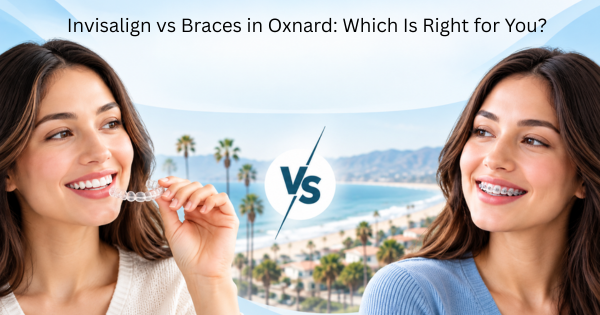
Invisalign uses removable clear aligners and works best for mild to moderate crowding, spacing and bite issues. Traditional braces use fixed brackets and wires and can handle the full range of cases, including complex ones. Cost is often similar, so the right choice depends on your teeth, your lifestyle and how consistently you'll wear aligners.
Choose Invisalign if:
- Your concerns are mild to moderate crowding, gaps or bite issues, and an exam confirms it.
- You want a discreet look at work, on camera or in photos.
- You’d like to eat what you want and brush and floss the normal way.
- You can wear the aligners 20 to 22 hours a day, every day.
Choose braces if:
- Your case involves heavy crowding, rotated teeth or a complicated bite problem.
- You’d rather not depend on remembering to wear something removable.
- You want treatment that works around the clock without your help.
- Your dentist recommends braces after examining your teeth.
Only an exam can put you in one list or the other. Use these as a starting point for the conversation.
How Invisalign Works
Treatment starts with a digital scan of your teeth. We use the Invisalign 5D intraoral scanner for this, which replaces the putty impressions many people dread. From the scan, a series of custom clear aligners is made, and each set moves your teeth a small amount. You switch to the next set every one to two weeks.
The catch is wear time. Aligners only work while they’re in your mouth, so the target is 20 to 22 hours a day. They come out to eat, to drink anything besides water, and to brush. Fall short for a few weeks and your teeth stop tracking the plan, which often means extra aligners and extra time.
Two details surprise people who assumed Invisalign® meant a few clear trays and nothing else. Some cases need small tooth-colored bumps, called attachments, bonded to a few teeth so the aligners have something to grip. Some also need tiny rubber bands, called elastics, to correct the bite. And a final set of refinement aligners near the end is common.
Dr. Georgia Haddad is a Premier Invisalign provider. Our Invisalign page has the full details on Invisalign in Oxnard.
How Traditional Braces Work
Traditional braces are brackets bonded to the front of your teeth, with an archwire running through them. The wire applies steady pressure, and your dentist adjusts it every few weeks to keep the movement going. You can’t take braces off, so they never stop working. For a hard case, or a patient who won’t reliably wear trays, that’s the entire argument in their favor.
The tradeoffs are the ones you’d guess. Hard and sticky foods come off the menu, brushing takes longer, and a bracket occasionally pops loose. Cleaning around the hardware matters more than most people expect, and our post on keeping gums healthy with braces covers the routine.
Our traditional orthodontics page explains the options for braces in Oxnard.
Invisalign vs Braces: Side by Side
| Invisalign | Braces | |
|---|---|---|
| Appearance | Clear aligners, hard to notice up close | Brackets and wires are visible |
| Comfort | Smooth plastic with no wires against your cheeks; teeth feel sore after each new set | Mouth irritation is common early on and after adjustments |
| Eating | Aligners come out, so few food limits | Hard and sticky foods are restricted |
| Cleaning | Remove the trays to brush and floss as usual | Brushing and flossing take more effort |
| Wear time | 20 to 22 hours a day, and it's up to you | Fixed in place, working 24 hours a day |
| Case range | Best for mild to moderate cases; some complex cases are possible | Handles the full range, including complex cases |
| Visits | Periodic check-ins | Regular adjustments, typically every few weeks |
| Typical time | Varies; mild cases can be shorter | Often about 18 months to 3 years |
| Cost | Often similar to braces | Often similar to Invisalign |
| Insurance | May fall under orthodontic benefits, if your plan has them | Same |
Which Cases Suit Which Treatment?
When Invisalign Is a Good Fit
Invisalign tends to work well for mild to moderate crowding, gaps between teeth, and some bite corrections. It’s also a common choice for adults whose teeth have shifted since braces years ago. If your main goal is a straighter smile without anyone noticing treatment, and you’re organized enough to keep up with the trays, you fit the typical candidate.
When Braces Are Usually the Better Choice
Braces earn their place on difficult teeth: severe crowding, teeth that are significantly rotated, and bite problems that need precise control of how teeth move up, down and sideways. They’re also the safer pick when compliance is the weak link.
Invisalign has improved a lot, and some cases that once required braces can now be done with aligners. Dentists disagree about where that line sits. That’s one reason to get an exam from a practice that offers both: nobody has a reason to steer you toward the option they happen to sell.
Invisalign vs Braces for Adults, Teens and Kids
Adults mostly choose on looks and schedule. If you spend your day in client meetings or on video calls, clear aligners remove a distraction.
With teens, the real question is compliance. Picture a 15-year-old who takes the trays out for lunch, wraps them in a napkin and throws the napkin away. It happens, and it’s a big reason some families choose braces. That’s a sensible call.
For younger children, early treatment is its own conversation. Our pages on early orthodontic treatment and Invisalign First explain when it makes sense to start before all the adult teeth are in.
Cost, Insurance and Financing
Here’s where we’d rather be useful than vague. Price depends on how complex your case is and how long treatment runs, and the national ranges you’ll find online are so wide they’re nearly meaningless. In many practices Invisalign and braces land in a similar range, which means cost alone rarely settles the decision.
We participate with Delta Dental and file most dental insurance claims, and we offer financing for treatment plans. Many plans treat orthodontics as a separate benefit with its own lifetime maximum, so check yours before you assume anything. If you have an FSA or HSA, ask whether orthodontic treatment qualifies. Our payment and insurance page has the details.
How Long Does Treatment Take?
Braces commonly run somewhere around 18 months to 3 years, depending on how much has to move. Mild Invisalign cases can finish faster, sometimes in under a year, while complex ones can take as long as braces or longer. Your own timeline comes from your scan and treatment plan, and it only holds if you follow the plan. Anyone promising an exact number before an exam is guessing.
What Happens After: Retainers
Both options end the same way, with retainers. Teeth drift back toward their old positions if you stop wearing them. Most patients wear retainers full-time for a short stretch and then at night for the long haul, though your dentist sets the schedule. Build them into the plan, and ask at the start what a replacement costs.
What to Expect at Your Consultation
The first visit is mostly looking and talking. We review your dental history, examine your teeth and bite, take a digital scan, and talk through what you want to change. Then you get a recommendation, a rough timeline and a cost discussion. You can read what to expect on our first visit page, and the smile gallery shows results from real patients.
Four questions worth asking, wherever you go:
- Is my case a good fit for Invisalign, or would braces likely give a better result?
- How long do you expect treatment to take?
- What happens if I don’t wear my aligners as directed?
- What will the total cost be, and what might my insurance cover?
Invisalign and Braces in Oxnard, Camarillo, Ventura and Port Hueneme
Our office is at 1801 Solar Dr., Suite 290 in Oxnard, open Monday through Thursday from 8 AM to 5 PM and Friday from 8 AM to 12:30 PM. Patients also come from nearby cities. If you’re coming from Camarillo, Ventura or Port Hueneme, ask about scheduling so your appointments fit your commute. You can also browse all of our orthodontic services.
Frequently Asked Questions
Is Invisalign more expensive than braces?
Often the two cost about the same, though it varies by case and provider. Complexity and treatment length drive the price more than the type of appliance. We’ll go over the cost with you after your exam.
Which is better for adults, Invisalign or braces?
Many adults prefer Invisalign for its discreet look and flexibility, and it works well for mild to moderate cases. Braces remain the stronger tool for complex ones. Which is better depends on your teeth.
Does Invisalign hurt more than braces?
Both cause soreness, mostly in the first few days of a new aligner set or after a braces adjustment. Many people find aligners gentler because there are no brackets or wires against the cheeks, though comfort varies from person to person.
Does Invisalign work faster than braces?
Sometimes, mainly for mild cases. For moderate and complex cases the timelines are often similar. Wearing the aligners as directed matters more than which brand you choose.
Can Invisalign fix bite problems?
It can correct some bite problems, often with elastics or attachments. Severe or complex bite problems may respond better to braces, which an exam will clarify.
Are braces more effective than Invisalign?
For complex cases, braces generally give more precise control. For mild to moderate cases, both can produce excellent results. Effectiveness comes down to matching the treatment to the case, and for aligners, to wearing them.
Ready to Find Out Which Fits Your Teeth?
Call Beach Cities Dental Group at (805) 278-8887 or request an appointment online.
We'll examine your teeth, answer your questions and recommend the option that fits.
1801 Solar Dr., Suite 290, Oxnard · Mon–Thu 8AM–5PM · Fri 8AM–12:30PM