
By Beach Cities Dental Group, Oxnard, CA
Holistic vs biological dentistry sounds like a debate with two clear sides. It isn’t. Holistic dentistry is the broad philosophy. Biological dentistry is a narrower, more materials-focused branch of it, and plenty of dentists use the two words as if they were identical. No licensing board defines either one, so the sign on the door tells you very little. What a practice does with your fillings, your X-rays and your root canals tells you far more.
What’s the difference between holistic and biological dentistry?
Holistic dentistry is a broad, whole-person philosophy; biological dentistry is usually a narrower, materials- and toxin-focused approach built around biocompatibility and protocols like SMART. Neither is a recognized dental specialty, and many practices use the terms interchangeably, so check credentials rather than the label. That’s the quick answer. The detail matters, because the gaps between the two show up in the exam room.
What is holistic dentistry?
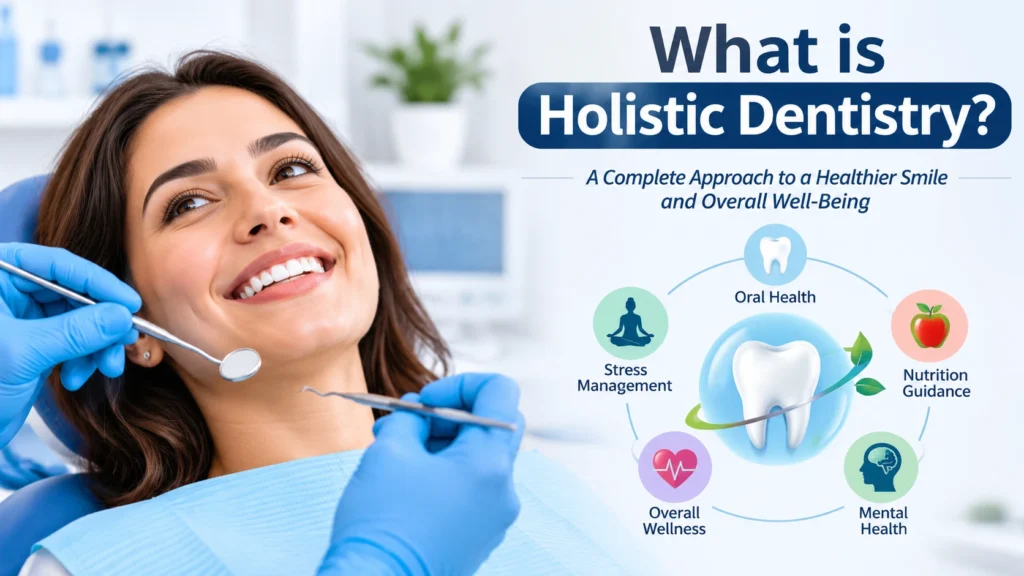
Holistic dentistry starts from the idea that your mouth and the rest of your body affect each other. A holistic dentist is likely to ask about your sleep, stress, diet and medications before reaching for a drill, and to favor the least invasive option that works. We cover our own approach on our holistic dentistry page, so here’s just the core: what happens in the dental chair, including which materials go in your mouth, is part of your whole-body health.
What is biological dentistry?
Biological dentistry (you’ll also see “biocompatible dentistry”) takes the holistic starting point and narrows it to one question: what is this material or procedure doing to your body over time? Biological dentists tend to avoid mercury amalgam altogether, choose metal-free options for crowns and implants, and follow a formal protocol when old fillings come out.
The best known protocol is SMART, the Safe Mercury Amalgam Removal Technique, developed by the International Academy of Oral Medicine and Toxicology (IAOMT). Typical safeguards include a rubber dam, high-volume suction, and filtered air or a separate oxygen supply for the patient. Dentists in this camp often belong to IAOMT or to the International Academy of Biological Dentistry and Medicine (IABDM).
Where holistic and biological dentistry overlap
Both camps agree on more than their marketing suggests. Both want to keep your natural teeth wherever that’s realistic. Both take gum inflammation seriously beyond the mouth (we explain how oral health affects the rest of the body in a separate article). Both prefer minimally invasive treatment. And both spend more time than average on explaining why a treatment is being recommended.
Land on either one and you’ll likely get a dentist who asks more questions than you’re used to.
Why the terms are so confusing
Neither term is a recognized specialty. According to the Academy of General Dentistry, accredited dental schools don’t offer specialized holistic training, and dentists who practice holistically went through the same education as any general dentist. They found their way to it later, through continuing education or personal conviction.
That leaves a gap, and marketing fills it. “Natural,” “integrative,” “biocompatible,” “alternative” and “bio” all circulate, sometimes meaning the same thing and sometimes not. Then there’s biomimetic dentistry, which sounds like a sibling. It isn’t one. Biomimetic work answers the question of how to rebuild a tooth so it behaves like natural tooth structure. Biological dentistry asks what the materials do to your body. Some practices offer both.
Holistic vs biological dentistry: side by side
| Holistic dentistry | Biological dentistry | |
|---|---|---|
| Core idea | Whole-person care; the mouth as part of the body | Biocompatibility; limiting toxic exposure from dental materials |
| Scope | Broad: nutrition, stress, sleep, prevention | Narrower and more clinical: materials, protocols, inflammation |
| Fillings | Tooth-colored composite usually preferred over amalgam | Mercury-free; usually composite or ceramic |
| Old amalgam fillings | Removed when there’s a clinical reason, often with extra precautions | Often removed under a formal protocol such as SMART |
| Root canals | Varies by dentist | Often avoided or kept to a minimum; extraction or alternatives discussed |
| Fluoride | Varies by dentist | Often cautious or avoided |
| Implants | Varies by dentist | Ceramic (zirconia) often preferred over titanium |
| Common organizations | Holistic Dental Association | IABDM, IAOMT |
| Typical language | “Natural,” “whole-body,” “integrative” | “Biocompatible,” “mercury-free,” “toxin-aware” |
Treat that table as a tendency, not a rule. Two practices that both call themselves biological can disagree about root canals, and two holistic practices can disagree about fluoride.
Credentials matter more than the label
Since the words guarantee nothing, look for evidence of training:
- IAOMT membership or accreditation, and SMART certification specifically if you want old amalgam fillings removed
- IABDM membership, common among biological practices
- Holistic Dental Association membership, common among holistic ones
- General credentials such as an AGD fellowship, which show ongoing education in dentistry as a whole
Memberships aren’t licenses. In California, every dentist, holistic or otherwise, has to be licensed by the Dental Board of California. A membership badge shows interest and some extra training. It doesn’t show clinical judgment.
What mainstream dentistry says
Mainstream dental organizations take a more cautious line on several biological-dentistry claims, and you should hear that before you decide.
Amalgam is the clearest example. The FDA considers dental amalgam safe for most people, while advising that some groups, such as pregnant women, young children and people with known metal sensitivities, may face more risk and should talk through alternatives with a dentist. The American Dental Association’s code of ethics calls it improper to remove amalgam fillings from a patient who has no allergy, purely to rid the body of toxins, when the only basis is the dentist’s own recommendation. That’s why a careful dentist of either type removes old fillings for a reason, such as decay, leaking, cracks or a documented sensitivity, and not as a detox.
Other claims, like root canal teeth causing disease elsewhere in the body, aren’t accepted by mainstream dental organizations.
Holistic care can still be a good fit. Ask for the reasoning behind any recommendation, especially one that involves removing something that isn’t causing a problem.
How we practice at Beach Cities Dental Group
We describe our approach in Oxnard as holistic with a biocompatible focus, which puts us nearer the holistic end of this spectrum. Dr. Haddad and Dr. Tapia offer:
- Tooth-colored composite fillings, which contain no metal, in place of silver amalgam
- Removal of old amalgam fillings for patients who need it, done to limit exposure to metals
- MELISA blood testing, a test used to look for metal sensitivities before we choose materials for your treatment
- An iTero digital scanner that captures detailed images of your teeth without radiation
- Filtered water in the office, to remove metals and contaminants that can linger in city water
We also offer root canal treatment. Which route makes sense for a given tooth depends on the tooth, and that’s a conversation for your exam.
Which should you choose?
Start with what you want most.
If you want a dentist who looks at the whole picture, including stress, sleep, nutrition and prevention, a holistic practice fits. Our post on the benefits of holistic dentistry goes through what that looks like day to day.
If you have a known metal sensitivity, or a firm preference for mercury-free work and a formal protocol for removing old fillings, look at a biological practice, or at a holistic one that offers biocompatibility testing and removal safeguards.
If you’re not sure, choose the dentist whose reasoning you understand. Many practices blend elements of both, so you don’t have to pick a camp before you book.
Questions to ask before you book
- Which materials do you use for fillings and crowns, and why?
- If I want old amalgam fillings removed, what protocol do you follow? Is it SMART?
- What’s your view on root canals, and when do you recommend extraction instead?
- How do you decide when I need X-rays or other imaging?
- What training or memberships do you hold beyond your dental license?
- Which of your recommendations go beyond standard dental care, and what’s the evidence behind them?
Frequently asked questions
Is holistic dentistry the same as biological dentistry?
Not quite, though they overlap heavily. Holistic dentistry is the broader philosophy of treating the whole person. Biological dentistry is typically narrower, with more focus on biocompatible materials and avoiding toxic exposure. Some practices use the two terms interchangeably.
Do biological dentists do root canals?
Some do and some avoid them. Many biological dentists discuss extraction or other alternatives first, while others still treat root canals when they judge the tooth can be saved. Ask the practice directly.
What is the SMART protocol?
SMART stands for Safe Mercury Amalgam Removal Technique. The IAOMT developed it to reduce mercury exposure for patients and staff when old amalgam fillings are removed, using measures such as barriers, strong suction and filtered air.
Does insurance cover holistic or biological dentistry?
Coverage usually follows the procedure, not the philosophy. A filling is a filling to most plans, though extras such as biocompatibility testing may not be covered. Our payment and insurance page is a good place to start.
Can a dentist be both holistic and biological?
Yes. Many practices blend the two, pairing the whole-person focus of holistic care with biocompatible materials and removal protocols.
Want to know how this applies to your own teeth?
Call us at (805) 278-8887. We’re open Monday through Thursday, 8 a.m. to 5 p.m., and Friday, 8 a.m. to 12:30 p.m.
Read how our emergency dentist in Oxnard care works, or see our post on same-day care for tooth pain and dental emergencies.
1801 Solar Dr., Suite 290, Oxnard · Mon–Thu 8AM–5PM · Fri 8AM–12:30PM
Sources
- European multicenter retrospective study of hospitalized patients with severe odontogenic infections, PubMed 41110539
- Severe odontogenic infections: a 5-year review of a major referral hospital in Ghana, PMC6561007
- RACGP, Australian Journal of General Practice, Dental abscess: a potential cause of death and morbidity