

By Beach Cities Dental Group, Oxnard, CA
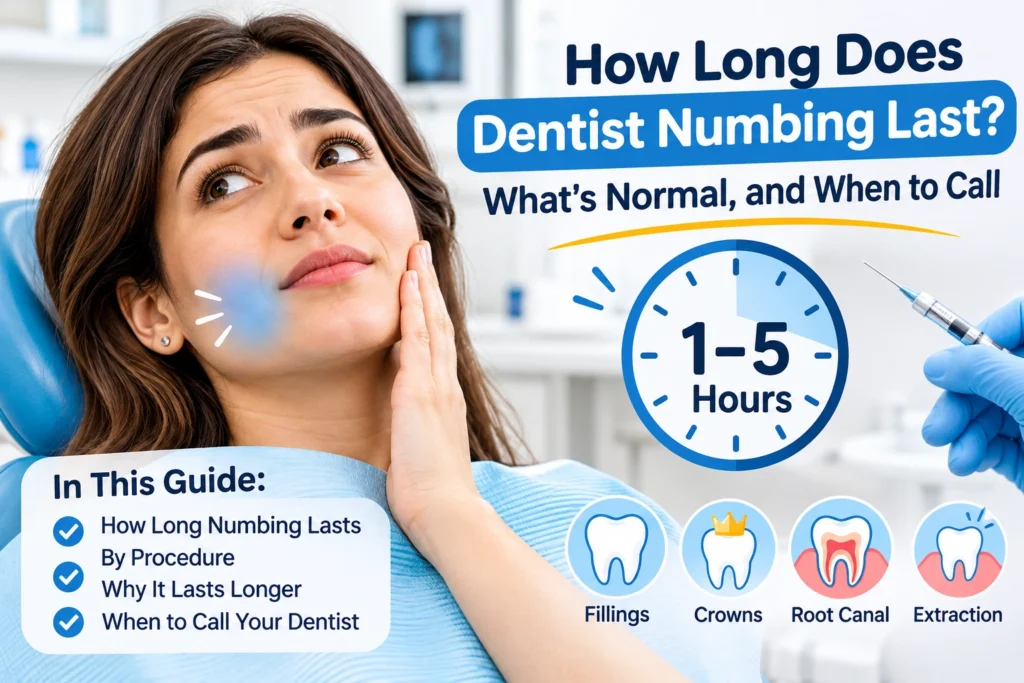
Most dental numbing wears off within a few hours. If you just left the chair and half your face feels like it belongs to someone else, that heavy, tingly feeling is normal, and it fades on its own. How long it takes depends on the anesthetic, where it was placed and what work you had done.
This guide explains how long dentist numbing lasts, why your timeline can differ from someone else’s, what waking up feels like, and when it’s time to call your dentist.
How Long Does Dentist Numbing Last?
Dental numbing from a local anesthetic usually wears off within a few hours. Your teeth typically regain feeling first, often within one to two hours, while your lip, tongue and cheek can stay numb a few hours longer. Lower-jaw work and longer-acting anesthetics last longer, so ask your dentist what to expect for your procedure.
Here's the usual sequence:
- Onset: Lidocaine, a common dental anesthetic, usually starts working within about five minutes.
- Teeth: They tend to wake up first, often in one to two hours.
- Lips, tongue and cheek: These can stay numb for several hours, often three to five.
- Bigger procedures: Higher doses and longer-acting anesthetics stretch the timeline.
How Long Numbing Lasts by Procedure
These are typical ranges for soft tissue numbness, meaning the lip, tongue and cheek. They’re averages, and yours may be shorter or longer.
| Procedure | Typical Numbness |
|---|---|
| Filling, Upper Jaw | About 1 to 3 hours |
| Filling, Lower Jaw | About 2 to 4 hours |
| Crown Preparation | About 2 to 4 hours |
| Root Canal | About 3 to 5 hours |
| Tooth Extraction or Wisdom Teeth | About 3 to 5 hours, sometimes longer |
| Deep Cleaning with Numbing | About 1 to 3 hours |
Longer visits tend to mean longer numbness. If you’re having a root canal in Oxnard, a tooth extraction in Oxnard or one of our dental crowns in Oxnard, each page explains what to expect from the procedure itself.
Why Your Numbness Lasts Longer or Shorter Than Someone Else's
Two people can have the same filling and feel very different afterward. These are the main reasons.
Which Anesthetic You Get
Lidocaine is the best-known dental anesthetic, and Delta Dental says its effects last about one to two hours. Other anesthetics are shorter or longer acting, and dentists choose one based on the procedure and your health history. Many people still call all of them Novocaine, but that drug was replaced by newer medicines years ago.
Whether It Contains Epinephrine
Many local anesthetics contain epinephrine, also known as adrenaline. It narrows blood vessels near the injection and slows how fast the anesthetic leaves the area, and it can make the numbness last up to an hour longer.
How Much You Need and Where It Goes
Higher doses last longer and are used for more complicated work. A root canal may need more than a filling. Location matters too. Numbing a single upper tooth covers a small area. A lower-jaw injection often reaches a nerve that serves your lower teeth, lip, chin and part of your tongue, so more of your mouth stays numb for longer.
The Condition of the Tooth
An infected tooth can be harder to numb. Infection can make the anesthetic less effective, so your dentist may need to use a higher dose.
Your own body plays a part too. Age, health and how quickly you process medicines can all shift the timeline, and none of that points to a problem.
Why Do Your Lips Stay Numb Longer Than Your Teeth?
As the anesthetic fades, you’ll usually feel your tooth before you feel your lips, cheeks or tongue. That’s expected. The nerve branches that serve your lip, cheek and tongue cover a larger area, so they take longer to recover than the nerve ending in a single tooth.
So if your tooth feels normal but your lip still feels thick, you haven’t missed a step. Give it a little more time.
Is It Normal? What Waking Up Feels Like
Expect some or all of these as the numbness fades:
- Tingling or pins and needles in the lip, chin or tongue.
- A heavy, swollen or droopy feeling that isn’t actually swelling.
- Slightly slurred speech or a little drooling.
- Mild, short-lived effects such as dizziness or a headache.
While you’re still numb, you can’t feel heat, pain or pressure properly. A few simple habits prevent injuries:
- Don’t chew gum or eat solid food. It’s easy to bite your cheek, lip or tongue without noticing.
- Skip hot drinks and soup until feeling returns.
- Don’t poke or rub the numb area.
- Keep an eye on children. They often chew on a numb lip or cheek without realizing it.
If you’ve had an extraction, follow our tooth extraction aftercare tips as well.
When to Call Your Dentist
Numbness that fades slowly is usually normal. Call your dentist if the numbness is much longer than they told you to expect, or if you still have little or no feeling the next day. Tingling or altered feeling that isn’t improving is worth a phone call too. Most of the time, lingering numbness is a temporary nerve irritation that clears up on its own, but your dentist should know about it.
Get emergency care right away if numbness comes with trouble breathing or swallowing, swelling of the face or throat, hives, or a racing heartbeat. Rare allergic reactions to a local anesthetic need immediate medical treatment, so call 911 or go to the nearest ER.
Numbing vs Sedation: Two Different Timelines
Local anesthesia and sedation do different jobs, and they wear off on different schedules. Numbing stops pain in one area. Sedation relaxes you. Sedation doesn’t take pain away by itself, which is why we use a combination of the two when it’s needed.
The aftereffects are different too. Nitrous oxide wears off quickly once the mask comes off. Oral sedation can take several hours to clear and you’ll need someone to take you home. Our sedation dentistry page explains each option. If dental anxiety keeps you away from the chair, a sedation dentist in Oxnard can help you get care comfortably.
Can You Speed It Up?
Not much, and the safest answer is patience. Delta Dental notes that a warm compress or gentle massage can help the anesthetic wear off sooner, as long as you’re careful not to bite down on the numb area or press too hard. Never apply heat inside your mouth, and check that a compress isn’t too hot, since you can’t judge temperature while numb.
Frequently Asked Questions
How long does dentist numbness last?
Most dental numbness lasts a few hours. Your teeth usually feel normal in one to two hours, and your lip, tongue and cheek can take a few hours longer. The anesthetic, the dose and the procedure all change the timeline.
Is it normal to be numb for 6 hours?
It’s on the longer side, but it can happen after lower-jaw work, longer procedures or longer-acting anesthetics. If it’s much longer than your dentist said to expect, or you notice swelling or breathing trouble, call your dentist or seek emergency care.
Why is my lip still numb when my tooth feels normal?
The nerve that serves your lip, cheek and tongue covers a bigger area than the nerve in one tooth, so it recovers later. Feeling usually returns to the tooth first.
Can I eat while my mouth is numb?
It’s best to wait until feeling returns. Numbness hides heat and pain, so you can burn or bite your mouth without noticing. If you have to eat, choose something soft and room temperature and chew on the other side.
Does the type of anesthetic matter?
Yes. Different anesthetics act for different lengths of time, and epinephrine can extend the effect. Your dentist picks one based on your procedure and health history.
Does numbing wear off faster in the upper jaw?
Often, yes. Upper-jaw numbing usually covers a smaller area, while a lower-jaw injection tends to numb more of your lip, chin and tongue and takes longer to fade.
Does numbing cost extra?
According to the American Dental Association, as reported by Delta Dental, local anesthesia is usually considered part of the treatment and shouldn’t carry a separate charge. If you’d like to be sure, ask for a pre-treatment estimate.
Questions About Numbing Before Your Visit?
Call Beach Cities Dental Group at (805) 278-8887 or request an appointment online. We're at 1801 Solar Dr., Suite 290 in Oxnard, open Monday through Thursday from 8 AM to 5 PM and Friday from 8 AM to 12:30 PM.
Read how our .
1801 Solar Dr., Suite 290, Oxnard · Mon–Thu 8AM–5PM · Fri 8AM–12:30PM