

If any of this is happening right now, stop reading. Call 911 or go to the ER if you have trouble breathing or swallowing, swelling of the neck or under the tongue, swelling around the eye, confusion, or a racing heart with fever. Swelling in your face? Call a dentist right away, and if nobody can see you quickly, go to the ER.
How long until a tooth infection kills you?
Nobody can give you an honest number, and the sites that do are guessing. Most infections take weeks or months to cause serious trouble. A few turn dangerous in hours. Death is rare, and when it happens it almost always involves an infection that went untreated.
How long does it take for a tooth infection to become life-threatening?
There is no reliable timeline. A tooth infection can take weeks or months to spread, but a deep neck infection can become life-threatening within hours. Death is rare in people who get care, yet swelling of the face or neck, fever, or trouble swallowing or breathing means urgent care now.
Why you’ll see “days” on one site and “months” on another
Search this question and you’ll find answers that can’t all be true. One dental blog says days. Another says you often have months. A third offers a schedule: one to two weeks, then one to two months, then more. None of them cite a source.
They can all sound right because they’re describing different infections. Where the infection sits matters more than how long it’s been there.
An abscess at the tip of a root sits in bone. It can smolder for weeks or months, and there’s no precise timeline for when one turns dangerous. An infection that breaks out into the soft tissue under the jaw and tongue gets no such patience. Ludwig’s angina, a swelling of the floor of the mouth and neck that can block the airway, can become life-threatening within hours. It’s most often linked to infections in the lower second or third molars.
Picture two people who both start the week with a toothache. (This is an illustration, not a patient story.) One has an abscess at the root of an upper tooth. By Friday there’s a bump on her gum and a bad taste: miserable, but stable. The other has a lower back molar, and by Friday his tongue feels thick and swallowing hurts. Same symptom on Monday. Completely different Friday.
The second factor is the person: their immune system, whether the infection has a way to drain, and how fast they get care. That’s why no honest source hands you one number.
Can a tooth infection actually kill you?
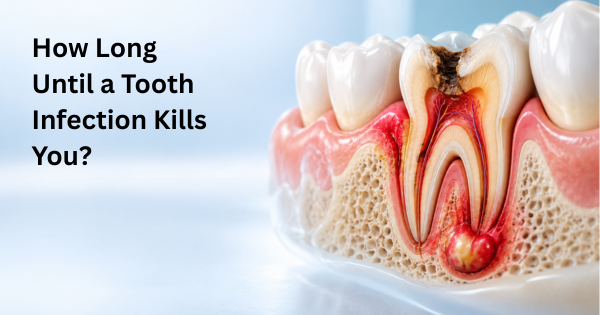
Yes, but rarely. The tooth itself isn’t the danger. The danger is where the bacteria go. An infection that can’t drain into your mouth spreads into the soft tissue of the face, which is cellulitis. From there it can reach the neck and airway, or enter the bloodstream and cause sepsis, a whole-body reaction that can lead to organ failure. In rare cases it reaches the brain or the heart.
How rare? One European multicenter study looked at 6,190 people hospitalized with severe tooth-origin infections. Eleven died, or 0.18%. Read that carefully: these were people sick enough to be admitted, so it isn’t the death rate for tooth infections in general. Most of them were previously healthy young or middle-aged adults.
Where care is harder to reach, the numbers look different. A five-year review at a teaching hospital in Ghana counted 14 deaths among admitted severe cases, 5.8%. Before antibiotics, an Australian review reports, fatality from dental abscess ran 10% to 40%. Ludwig’s angina killed over half its patients in that era and now kills under 10%.
The pattern is hard to miss. Death from a tooth infection tracks with how long and how far an infection goes untreated.
How a tooth infection spreads, stage by stage
- Bacteria get in. A cavity, a cracked tooth or gum disease opens a path to the pulp, the soft tissue inside the tooth.
- The infection becomes an abscess. A pocket of pus forms at the tip of the root or beside it in the gum. This is the stage where a dentist can usually fix it, with a root canal in Oxnard or, if the tooth can’t be saved, an extraction.
- It spreads to the jaw, face or neck. Facial cellulitis shows up as redness, swelling and pain. Ludwig’s angina is the version that threatens the airway.
- It reaches the bloodstream. That’s sepsis: fever and chills, a fast heart rate, fast breathing, confusion, extreme weakness.
- Rare deep spread. The infection can reach the brain (a brain abscess), the space behind the eye (cavernous sinus thrombosis, a blood clot) or the heart (endocarditis, an infection of the heart’s inner lining).
Most people never get past step two. Knowing the rest is how you recognize step three when it arrives.
Signs a tooth infection has spread
Pain level is a poor guide. Where the symptoms are matters more. This table is a starting point, not a diagnosis.
| Sign | What it may mean | Where to go |
|---|---|---|
| Throbbing tooth pain, sensitivity, swollen gum, bad taste, no fever, no facial swelling | Local infection or abscess | Dentist the same day |
| Pimple-like bump on the gum, pus | Abscess draining | Dentist the same day |
| Swelling of the cheek or jaw | Spread into soft tissue (cellulitis) | Dentist right away; ER if you can't be seen quickly |
| Swelling of the neck or under the tongue, trouble swallowing, tight or hard breathing | Possible airway-threatening infection such as Ludwig's angina | 911 or ER now |
| Swelling around the eye, vision change, severe headache, stiff neck | Possible spread toward the eye or brain | ER now |
| Fever with chills, fast heart rate, fast breathing, confusion, extreme weakness | Possible sepsis | 911 or ER now |
| Pain suddenly stops but swelling or bad taste stays | The nerve may have died; infection can continue | Dentist within days, sooner if swelling develops |
Who is at higher risk
The usual risk factors: uncontrolled diabetes, a weakened immune system (an organ transplant or HIV, for example), smoking, heavy alcohol use, poor oral hygiene, and long stretches of avoiding the dentist. Very young and older patients are often watched more closely too.
Having none of those doesn’t make you safe. In the European study above, most hospitalized patients were previously healthy, and having other medical conditions wasn’t linked to a longer stay or a worse outcome. An untreated infection is a risk for anyone.
If the pain stops, is the infection gone?
Usually not. Say the toothache was a 9 on Tuesday and a 2 on Thursday. It feels like winning. Sometimes it’s the nerve inside the tooth dying, and the bacteria are still there.
Many tooth infections never hurt at all and turn up on a routine X-ray. An abscessed tooth won’t heal on its own. That’s the practical case for regular checkups: X-rays catch what your mouth doesn’t report.
What treatment looks like
Treatment depends on where the infection started and how far it’s gone. A dentist may drain an abscess, clear the infected tissue out of the tooth with a root canal, or pull the tooth. A gum abscess starts with cleaning under the gum, which is where periodontal therapy comes in. When swelling is significant, the hospital route is IV antibiotics and drainage.
Antibiotics play a supporting part. An Australian review of dental abscess deaths and complications puts it plainly: once an abscess spreads beyond the tooth, it needs dental treatment and won’t respond to antibiotics alone.
Whether to save the tooth or pull it, and whether to do it the same day, is its own question. We cover it in what dentists do when an infected tooth needs to come out, and our full root canal guide covers the other path. If extraction is the plan, our page on tooth extraction in Oxnard explains what to expect.
What to do tonight if you can’t be seen yet
Rinse with warm salt water and take over-the-counter pain relief as the label directs. Hold a cold compress against the outside of your cheek. Don’t put heat on a swollen area or aspirin directly on the gum, and don’t try to pop or drain anything.
None of this treats the infection. It takes the edge off until someone can. If anything from the red-flag box at the top shows up overnight, go to the ER.
Worried about cost, or afraid of the dentist?
These are the two big reasons people wait, and waiting is how many fixable infections get worse. On cost, see our payment and insurance options. We offer financing and work with Delta Dental. If fear is what’s keeping you away, our dental anxiety page explains what an Oxnard sedation dentist can offer, and you can tell us you’re nervous when you call.
Frequently asked questions
How do you know if a tooth infection is killing you?
You can’t judge it by pain. Watch for signs of spread: swelling of the neck, the floor of the mouth or around the eye; trouble swallowing or breathing; fever with chills, a fast heart rate or confusion. Any of those means the ER. The table above covers the rest.
How common is it to die from a tooth infection?
Rare. In a European study of 6,190 people hospitalized for severe tooth-origin infections, 11 died (0.18%). That counts only people sick enough to be admitted, so it isn’t a rate for every tooth infection.
Can the human body fight off a tooth infection?
Sometimes it holds a mild one back for a while. A serious one, no. An abscessed tooth won’t heal on its own, and the immune system is unlikely to clear a serious tooth infection without treatment.
How long does a tooth infection take to spread to your brain?
There’s no reliable timeline, and it’s rare. Treat a severe headache, stiff neck, vision change, swelling around the eye or confusion with a known tooth infection as an ER visit.
Can a tooth infection cause eye swelling?
Yes. An infection can spread toward the area around the eye, and swelling there is an ER sign, not a wait-and-see sign.
Can a tooth infection affect my heart?
Rarely. Oral bacteria can enter the bloodstream and cause infective endocarditis, an infection of the heart’s inner lining. It’s one more reason to treat an infection instead of living with it.
Can a tooth infection make you tired?
It can. Fighting an infection is tiring. Fatigue alone isn’t cause for panic, but extreme weakness along with fever, a fast heart rate or confusion is a sepsis warning sign.
Will a tooth infection go away on its own?
No. The pain may fade and the swelling may drop, but the source is still inside the tooth, and it usually comes back. How long a tooth infection lasts depends on when it’s treated.
How we handle a suspected infection at Beach Cities Dental Group
Call us at (805) 278-8887. We’re open Monday through Thursday, 8 a.m. to 5 p.m., and Friday, 8 a.m. to 12:30 p.m.
Read how our emergency dentist in Oxnard care works, or see our post on same-day care for tooth pain and dental emergencies.
1801 Solar Dr., Suite 290, Oxnard · Mon–Thu 8AM–5PM · Fri 8AM–12:30PM
Sources
- European multicenter retrospective study of hospitalized patients with severe odontogenic infections, PubMed 41110539
- Severe odontogenic infections: a 5-year review of a major referral hospital in Ghana, PMC6561007
- RACGP, Australian Journal of General Practice, Dental abscess: a potential cause of death and morbidity