

By Beach Cities Dental Group, Oxnard, CA
This guide covers how to fix crooked teeth with the six methods dentists actually use, what each costs in the US, and how long each takes. The short version: some fixes move your teeth, and some only make them look straighter. Knowing which is which saves you money and a second round of treatment.
Want a diagnosis instead of a guide? Our page on crooked teeth treatment in Oxnard explains how we handle it in person.
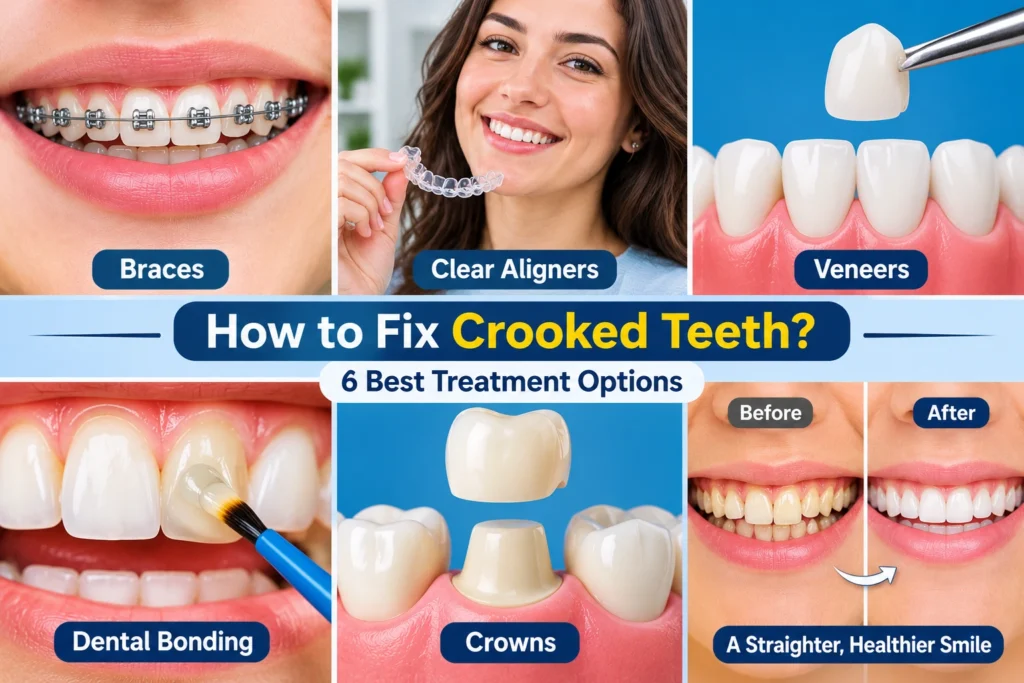
How to fix crooked teeth: 6 options at a glance
Crooked teeth are fixed by moving them with braces or clear aligners, usually over 6 to 24 months depending on severity. Veneers, bonding and crowns can make mildly crooked teeth look straighter, but they don’t move teeth. Severe jaw-related cases may also need surgery. An orthodontist or dentist can tell you which option fits.
| Option | Moves Your Teeth? | Best For | Typical US Cost* | Typical Time |
|---|---|---|---|---|
| Braces | Yes | Moderate to severe crowding, rotated teeth, and bite problems | $2,500 to $8,000 | About 12 to 24 months |
| Clear Aligners | Yes | Mild to moderate cases | $1,200 to $8,000 | About 6 to 18 months |
| Veneers | No | Mildly crooked front teeth | $470 to $2,500 per tooth | 2 or more visits |
| Dental Bonding | No | One or two slightly crooked teeth | $250 to $1,500 per tooth | Usually one visit |
| Crowns | No | A damaged tooth that is also crooked | $300 to $3,000 per tooth | 1 to 2 visits |
| Jaw Surgery Plus Braces | Yes (jaw and teeth) | Crookedness caused by the jaw | Quoted case by case | Varies |
- Read the second column again. Only braces, aligners and surgery change where your teeth sit. Veneers, bonding and crowns change what you see. When you’re choosing, that difference matters more than the price tag.
How crooked are your teeth, really?
Smile in a mirror and see which of these four sounds like you.
Mild. One tooth is slightly twisted, or the bottom front teeth overlap a little. Aligners often handle this. Some people in this group are fine with cosmetic work instead.
Moderate. Several teeth overlap or rotate, and the crowding is obvious. This is braces or aligner territory, and an orthodontist or dentist should pick which.
Severe. Teeth sit outside the arch or stack on top of each other. Braces are the realistic route.
Jaw-related. Your teeth look crooked, but the real issue is how your upper and lower jaws meet: an overbite, underbite or crossbite. Veneers can’t fix a bite.
A mirror can’t diagnose a bite, so treat this as a rough sort. An exam settles it.
1: Braces
Braces are the most flexible fix, and the one that still works when nothing else will. Brackets bonded to each tooth hold an archwire that applies steady pressure, so the orthodontist controls how each tooth moves. Crowding, rotation, bite problems and gaps are all fair game.
You’ve got four styles to choose from. Metal braces are the classic and the easiest to spot. Ceramic brackets blend in with your teeth but are a little less durable. Lingual braces sit behind the teeth, so nobody sees them, and they cost noticeably more. Self-ligating braces skip the elastic ties and can mean fewer adjustment visits.
The catch: brushing and flossing take longer with brackets in the way, and plaque builds up fast when people rush it. Gum trouble during treatment usually starts there.
Read more about traditional orthodontics at our office, or see what braces cost.
2: Clear aligners
Clear aligners are custom plastic trays that move your teeth a little at a time. You switch to a new set about every one to two weeks, and you wear them roughly 20 to 22 hours a day, taking them out only to eat and clean them. Invisalign is the best-known brand.
Here’s the honest part. Aligners only work while they’re in your mouth. If you pop them out for every coffee and every meeting, your teeth won’t move on schedule and treatment drags on. Someone who likes the idea of aligners but knows they’ll live in the case is often better off with braces.
Aligners also aren’t for every case. Severe crowding, big rotations and bite problems may need braces. Mail-order aligner kits cost less and are monitored remotely, which can work for mild cases. If you go that way, make sure a licensed dentist has reviewed your X-rays first. Without that, nobody has checked your gums or roots before the teeth start moving.
We compare the two head to head in Invisalign vs braces.
3: Veneers
Veneers are thin porcelain or composite shells bonded to the front of your teeth. They can make mildly crooked front teeth look straight in a couple of visits. They don’t move anything. The teeth underneath stay where they were, crowding included, so cleaning stays as hard as before.
Most veneers are a long-term commitment. Porcelain ones typically last 10 years or more with care, and some designs involve removing a little enamel. They suit a mild, purely cosmetic concern. For moderate or severe crowding they’re the wrong first move. Porcelain veneers at our office start with a consultation.
4: Dental bonding
Bonding uses tooth-colored resin that the dentist shapes directly on the tooth. It’s usually a single visit, and it costs far less than veneers. It works for one or two slightly crooked, chipped or uneven teeth. It won’t hide major crowding, and the resin tends to stain and chip sooner than porcelain.
Stuck between the two? Bonding vs veneers breaks down the trade-offs, and our tooth bonding page explains the procedure.
5: Dental crowns
For crooked teeth, crowns are a last resort. Shaping a tooth for a crown removes a lot of healthy structure. They make sense when a crooked tooth is also cracked, worn or heavily filled, and you need a dental crown anyway. Getting one only to straighten a smile is rarely a good trade.
6: Jaw surgery
When crooked teeth come from jaws that don’t line up, braces alone can’t finish the job. Orthognathic surgery repositions the jaw, and it’s almost always paired with braces before and after. Adults are the usual candidates, because their jaws have stopped growing. Kids with the same problem can often skip surgery, since appliances can guide jaw growth while it’s still happening. It’s rare, and your orthodontist will tell you plainly if you’re in that group.
Can you fix crooked teeth without braces?
Sometimes. Clear aligners move teeth without brackets, and veneers or bonding can cover mild crookedness. But “without braces” doesn’t mean without a dentist. Anything that actually moves teeth needs a professional plan.
What doesn’t work is the internet version. Tongue-posture exercises and better chewing habits may help children whose jaws are still developing, but they won’t move adult teeth that are already crooked. DIY tricks like rubber bands or pushing teeth with your fingers can crack teeth and cause infections. Skip them.
How much does it cost to fix crooked teeth?
Braces typically run $2,500 to $8,000 and aligners $1,200 to $8,000. Cosmetic options are priced per tooth: $250 to $1,500 for bonding and $470 to $2,500 for veneers. Those ranges are wide because they should be. Your price depends on how severe the case is and how long treatment runs.
Per-tooth pricing adds up fast. Veneers on six teeth can cost as much as, or more than, braces for your whole mouth, and they still won’t move a single tooth.
Insurance usually skips cosmetic work. Some plans pay a portion of orthodontic treatment, so check yours before you assume the answer is zero. Our payment and insurance page covers what we accept.
How long does it take to fix crooked teeth?
Braces typically take about 12 to 24 months, and harder cases run longer. Aligners take about 6 to 18 months for most people. Veneers and bonding take days to a couple of weeks of appointments. Jaw surgery adds a recovery period on top of the braces timeline.
Don’t choose on speed alone. A quick cosmetic fix on a crowded mouth leaves the crowding exactly where it was.
Fixing crooked teeth in kids vs adults
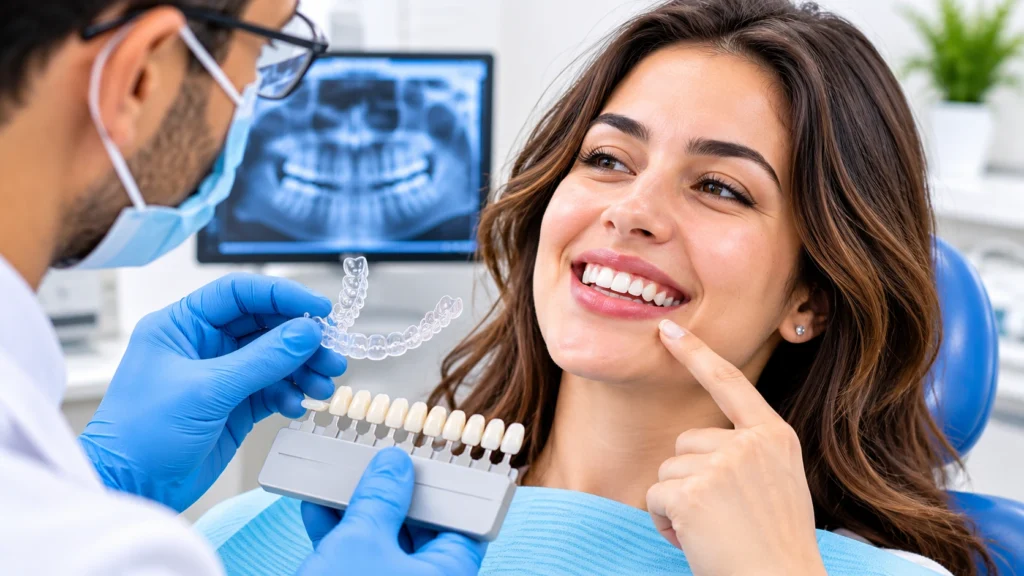
Kids. The American Association of Orthodontists recommends a first orthodontic evaluation by age 7. That doesn’t mean braces at 7. It means a dentist can spot jaw or crowding problems while growth can still be guided. Our early orthodontic treatment starts as young as 7. And if baby teeth come in crooked, the permanent ones won’t automatically follow.
Adults. You’re not too old. Teeth move at any age as long as your gums and bone are healthy, which is why gum disease gets treated first. Many adults pick aligners or ceramic braces to keep treatment discreet. Our post on straightening teeth as an adult covers the options.
What to expect at your first visit
A good first visit has four parts:
- An exam of your teeth and gums, plus a bite check, usually with X-rays.
- A digital scan of your teeth with our intraoral scanner.
- A conversation about what bothers you and what budget you’re working with.
- A written plan with the recommended option, the timeline and the cost.
More on your first visit is on our patient page.
Keeping your teeth straight: retainers and relapse
Teeth drift. The bone and gums need time to settle around the new position, which is why retainers matter after braces or aligners. Skip them, and the crookedness can return.
A retainer holds teeth in place. It isn’t a way to straighten crooked teeth from scratch. After earlier treatment, a dentist may use a retainer-style appliance to nudge teeth back from slight shifting, but that’s a limited job.
Frequently Asked Questions
Can crooked teeth be fixed in adults?
Yes. Healthy gums and bone matter more than your age. Adults can use braces or aligners, and some choose cosmetic options for mild cases.
Can veneers fix crooked teeth?
They can make mildly crooked teeth look straight, but they don’t move them. Moderate and severe cases need the teeth moved first.
Can retainers fix crooked teeth?
Not from scratch. Retainers keep teeth in their current position. Only orthodontic treatment moves crooked teeth into a new one.
How do you fix one crooked tooth?
It depends on how far the tooth is out of line. Options include partial orthodontic treatment, aligners, or bonding and veneers when the problem is mild and cosmetic.
Can you fix crooked teeth naturally?
Not once adult teeth are crooked. Good oral habits protect your teeth, but they won’t move them. Orthodontic treatment, and sometimes surgery, does that.
Can teeth become crooked again after braces?
Yes. It’s called relapse, and it’s the reason retainers exist. Wear yours as your dentist tells you